
Tool for operational planning
Fire Hose Calculator
This fire hose calculator is the result of our long-standing scientific work on operational fire protection and water supply. It is based on our own measurement series of friction pressure loss. Unlike conventional calculators, it does not apply the Darcy-Weisbach equation for rigid pipes; instead, it accounts for the fact that fire hoses behave hydraulically differently from rigid pipes and change their cross-section with pressure.
Basis of Calculation
Measured, not estimated
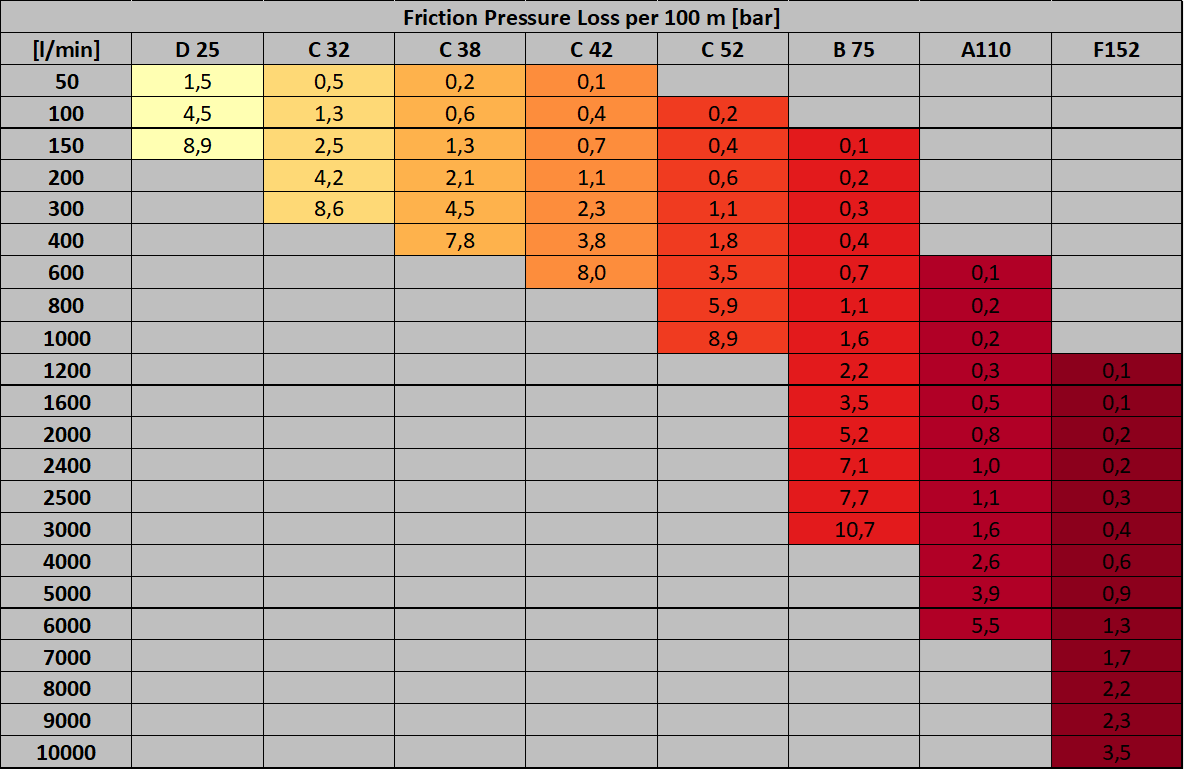
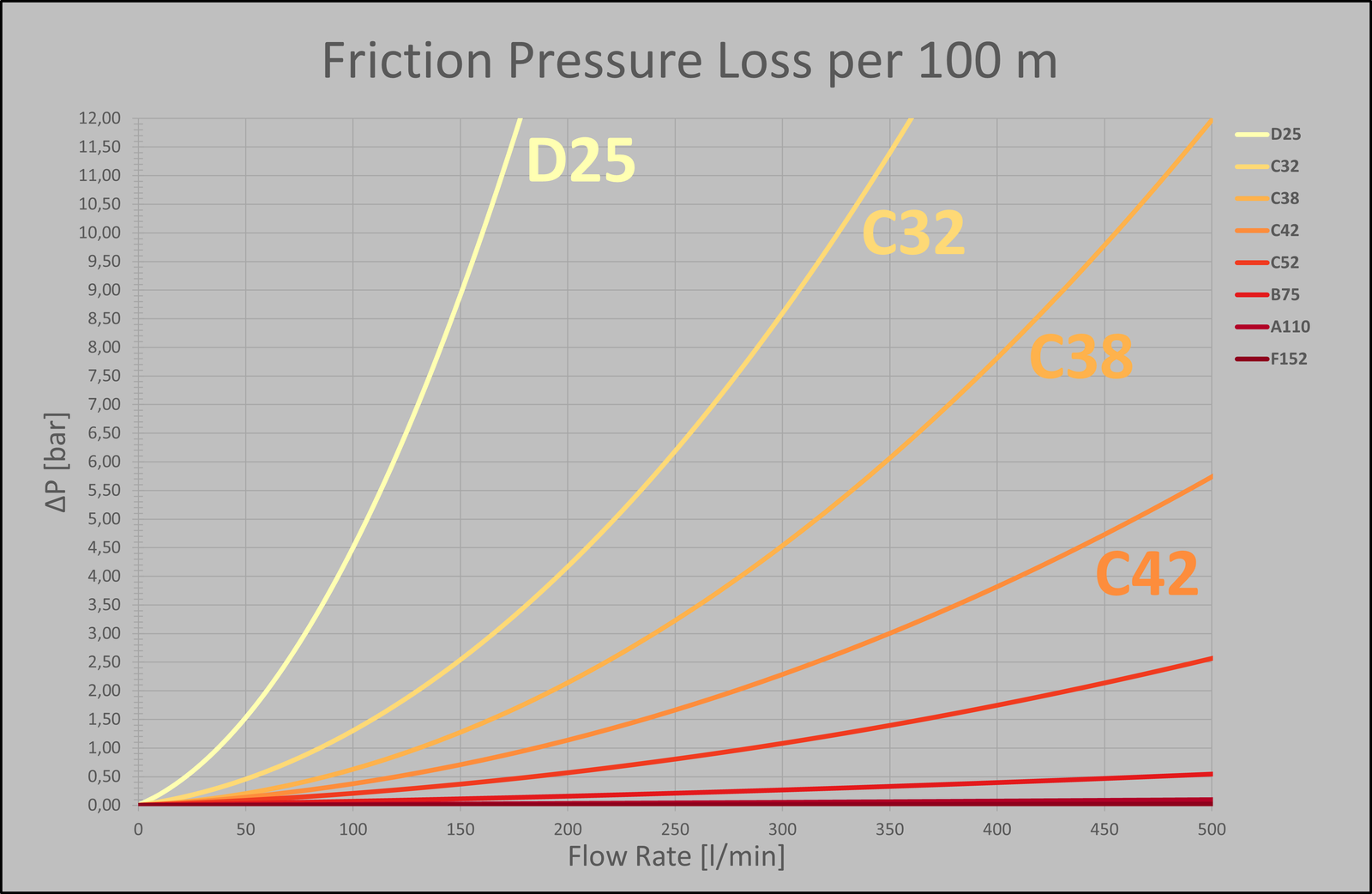
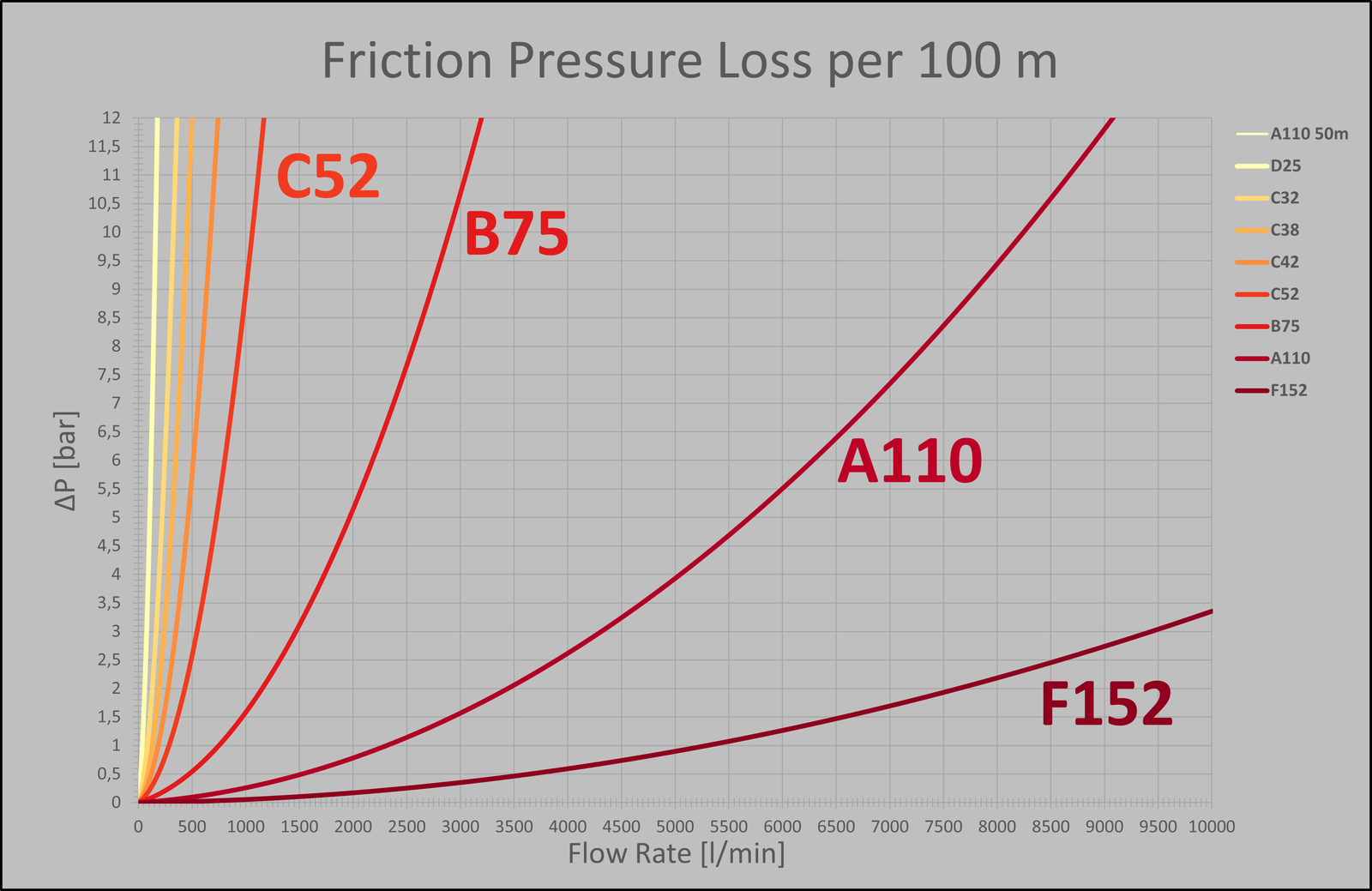
The calculations provided here are approximate values based on careful in-house measurements taken on 100-meter hose lines laid out either in a straight line or flaked on flat ground. The underlying tests were conducted with a pressure range of 1 bar to 12 bar and with a flow rate of up to 9000 l/min on the following hoses:
- D25 30 m Gollmer&Hummel Titan X-Treme
- C32 15 m Gollmer&Hummel Titan 2F
- C38 15 m Gollmer&Hummel Titan X-Treme
- C42 15 m Gollmer&Hummel Titan X-Treme
- C52 15 m Gollmer&Hummel Titan X-Treme
- B75 20 m Gollmer&Hummel Titan X-Treme
- A110 50 m Gollmer&Hummel Progress Supply
- F152 50 m Gollmer&Hummel Progress Supply
Values outside this range are no longer based on precise measurement data and should be regarded as estimates. Unlike many other calculation models, this calculator does not rely on a constant friction coefficient. Instead, it uses a curve based on numerous data points for each hose diameter, reflecting the flow behavior of modern fire hoses, which differs from that of rigid pipes.
It should be noted that coupling intervals with Storz couplings have no significant impact on the calculated values.
The results provided are intended as guidelines and may vary slightly in practice. Additionally, manufacturing tolerances in fire hoses, particularly for smaller diameters, can have a considerable influence on hydraulic performance.
Calculations for hose diameters of 34 mm, 40 mm, 45 mm, 51 mm, 66 mm, 70 mm, and 77 mm are marked with an *, as they are not based on direct measurements but derived through interpolation between measured values. Due to their proximity to the tested hose sizes, they are expected to provide a reasonable approximation.
As with the measured diameters, these interpolated values do not rely on a constant pipe friction coefficient. Instead, the calculations account for variations in hose cross-section resulting from pressure loss along the length of the hose.
Measurement Series
Tables and characteristic curves
© 2024-2025 Frank Reuter, Dr. Thomas Große et al.