
Solid-material fires
Deeper penetration into wood, textiles and smouldering nests: less overhaul work, lower water demand.
Mobile · Precisely dosed
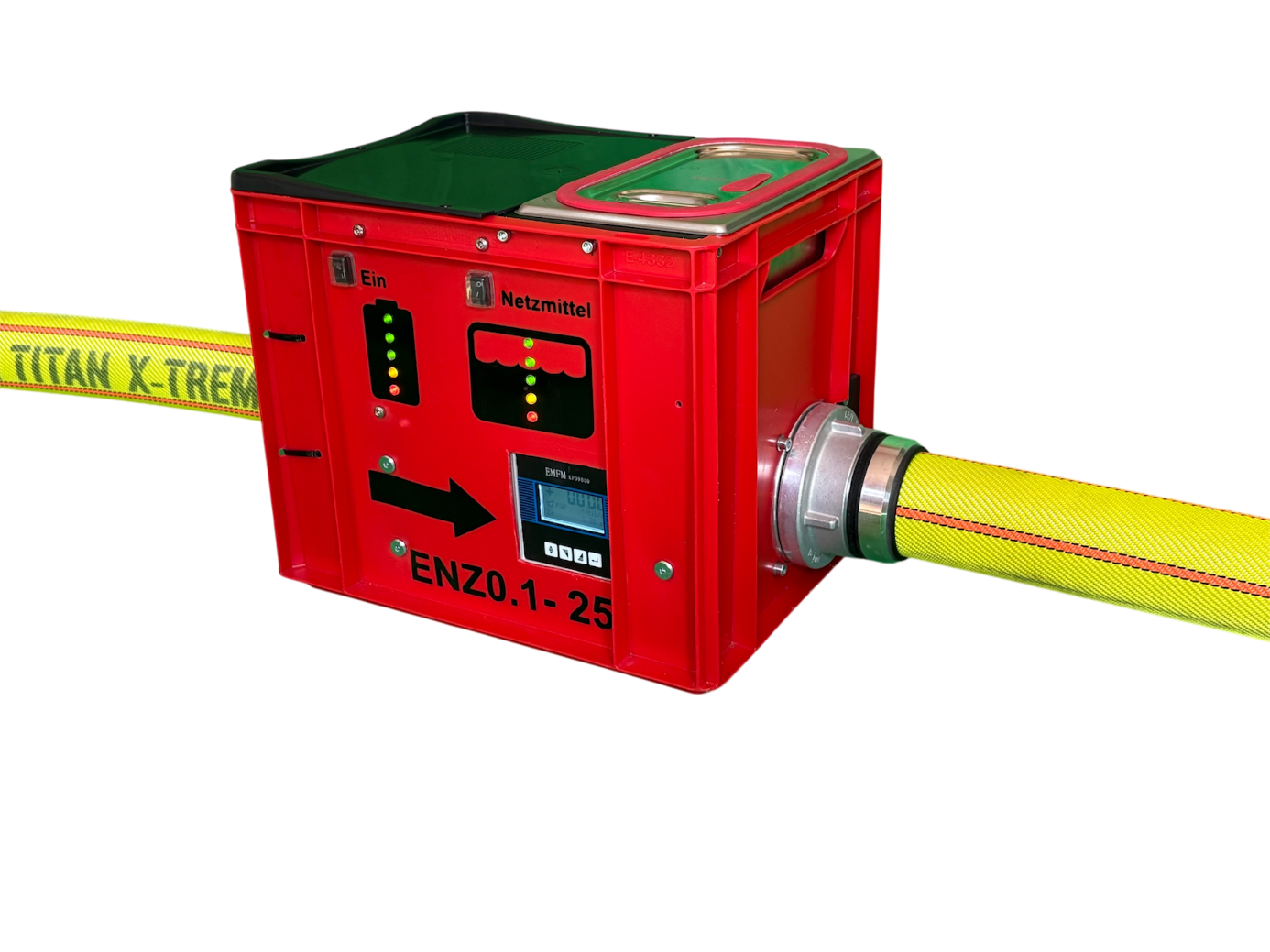
WetTron makes highly effective liquid concentrate available on the move: compact, battery-powered and ready for immediate use. The dosing stays precise even when the flow rate fluctuates.
Particularly effective where water has to penetrate deep into the burning material.
less firefighting water needed for solid-material fires
Comparison test · see Evidence
wetting agent on board: couple up, switch on, dose. Ready for use even without an external concentrate supply.
pressure loss at 2500 l/min
Knowledge · Wet water
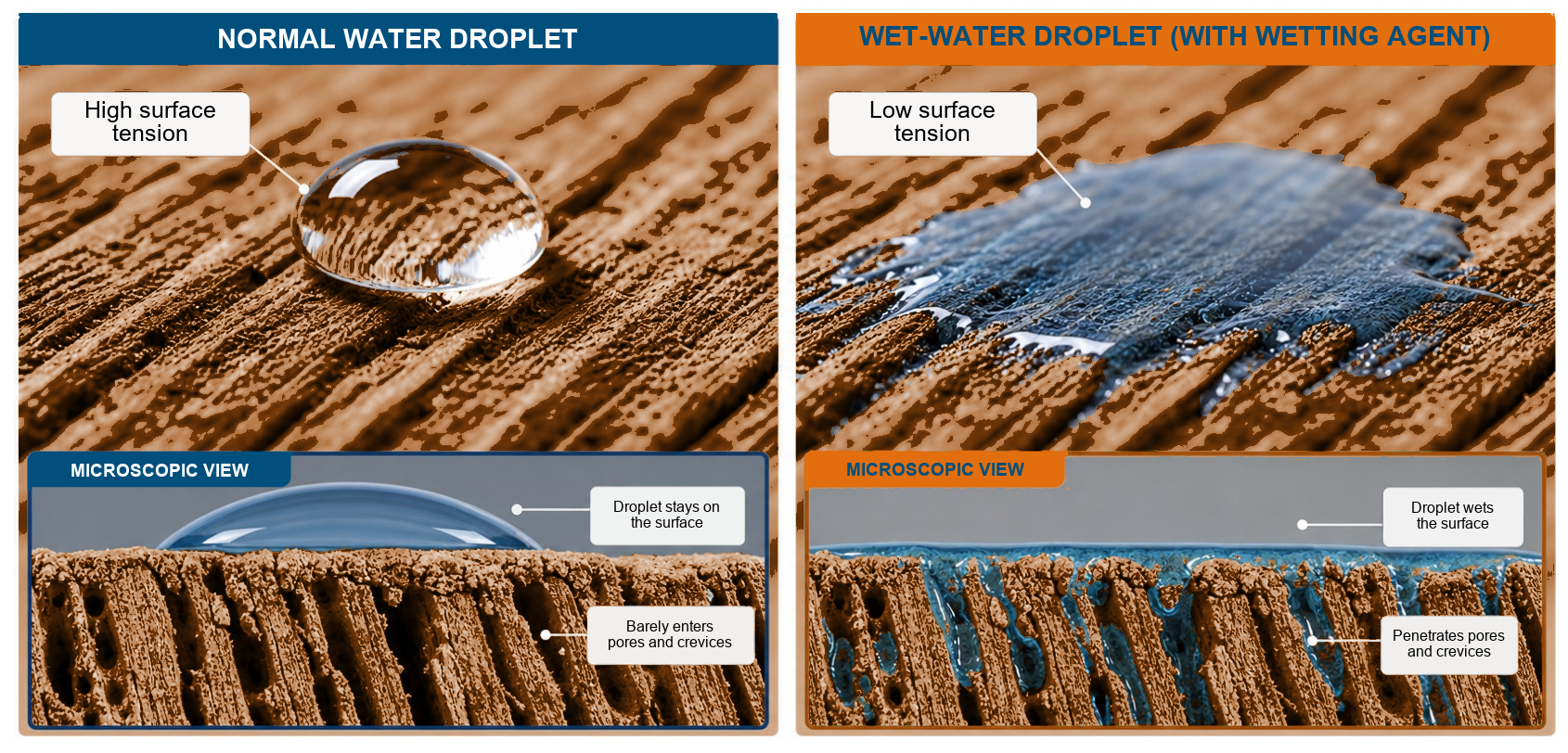
Wet water is firefighting water to which a wetting agent or multi-purpose foam concentrate is added in low concentration. Because of their molecular ability to reduce the surface tension of water, wetting agents are also called surfactants. Depending on the application, the proportioning rate is typically between 0.1 % and 0.3 %.
The improved wetting ability allows the firefighting water to penetrate the burning material far more deeply than ordinary water. This improves heat absorption and makes firefighting considerably more efficient.
Even small amounts of wetting agent can increase the extinguishing effect significantly: fires can be fought faster and with up to 50 % less water. This reduces water damage, the discharge of contaminated firefighting water into the environment and the thermal load on personnel. Water consumption and foam-concentrate demand drop noticeably.
 Operating principle
Video footage protected by copyright. Reproduction or distribution only with prior written permission.
Benefits at a glance
 Technology demonstrator
Why WetTron
Because modern wetting and foam agents are biodegradable, keeping pre-mixed wet water in stock on emergency vehicles (premix) is hardly feasible today. To take advantage of wet water nonetheless, WetTron was developed as a mobile and cost-efficient proportioning system.
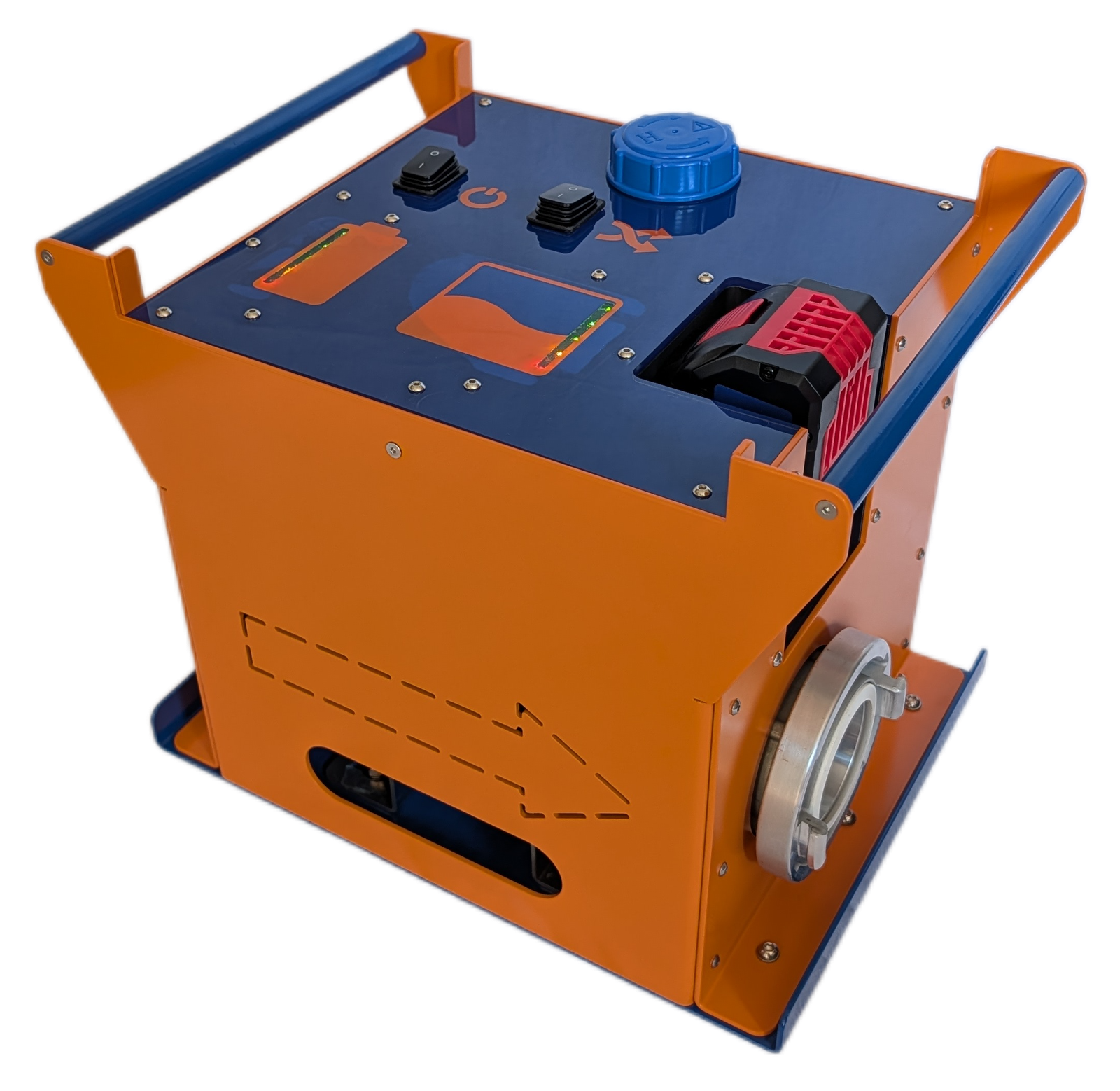
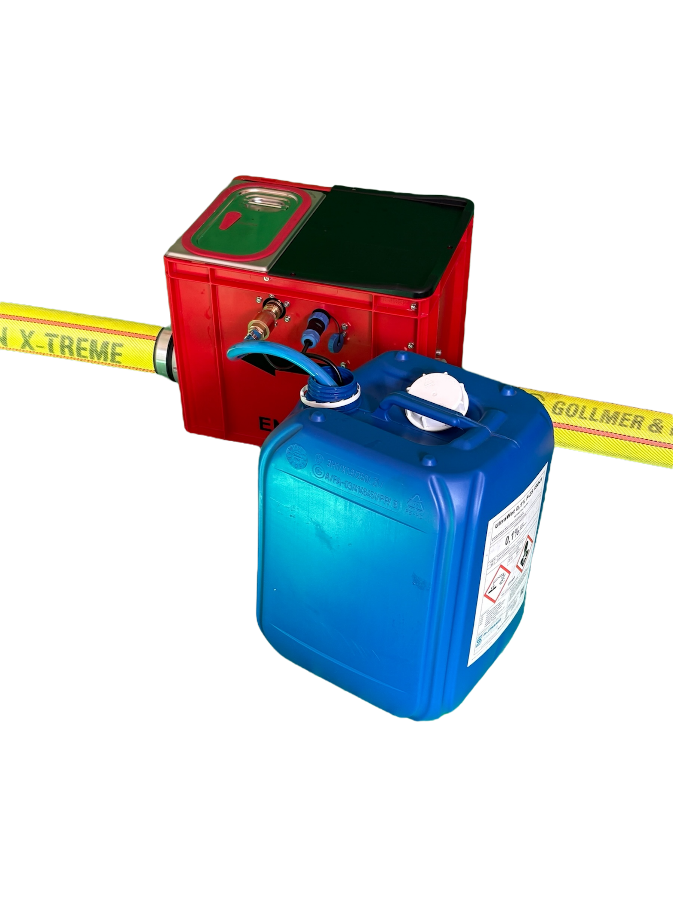
WetTron doses electronically and on battery power, not driven by the firefighting water flow. The wetting agent is already on board in the integrated 5 l tank: couple up, switch on, dose. It needs neither a minimum flow rate for its drive nor a separate concentrate container. For large volumes of water or long operations, an external concentrate supply can additionally be connected, for example directly from the canister. The basic principle remains that of a self-sufficient complete system that requires no preparation.
Thanks to its special pressure-proportioning method, WetTron works across an exceptionally wide flow range: reliably from as little as 10 l/min, including in start-stop operation, all the way up to 2500 l/min. This makes the system suitable both for low flows, for example when opening and closing the nozzle quickly during pulse application, and for high outputs during extensive firefighting operations.
Unlike many conventional proportioners, WetTron causes no restrictions of operational significance from back pressure: with a pressure loss of just 0.07 bar, water can still be delivered without restriction even over long distances.
This offers clear advantages especially in wildfires: WetTron can be used directly at the vehicle without limiting the downstream water supply or hose lengths. Its compact, mobile design enables rapid deployment in the initial attack, integrated directly into the attack line and without elaborate preparation.
As a standalone device, WetTron is more economical and more flexible than a fixed vehicle installation: a single unit can be used across vehicles, carried along or passed on, without tying up a vehicle permanently or requiring conversions. Anyone who wishes to can nevertheless install WetTron permanently in a vehicle at any time; the choice remains open.
Technical specifications
| Proportioning rate | 0.1 %, variably configurable |
|---|---|
| Working range | 10 to 2500 l/min |
| Flow resistance | 0.07 bar at 2500 l/min |
| Battery capacity | > 150 l concentrate per charge |
| Max. back pressure | > 12 bar |
| Dimensions | 40 × 30 × 35 cm |
| Weight | 13 kg / 19 kg ready for use |
| Connections | Storz B |
| Tank | 5 l, internal, refillable during operation |
 Canister operation
The self-priming pump allows direct operation with liquid concentrate straight from the canister.
Your benefit
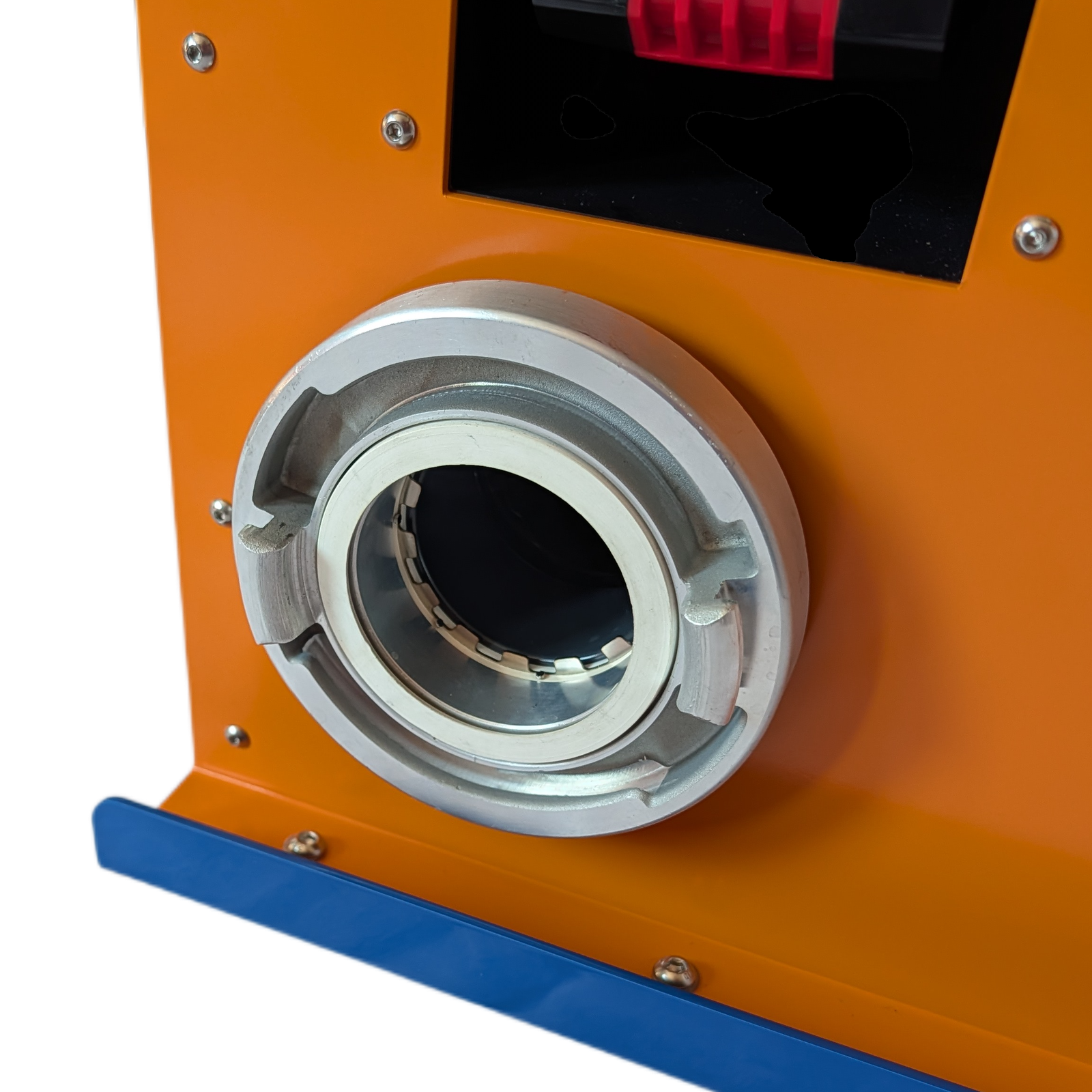 Connection detail
Evidence
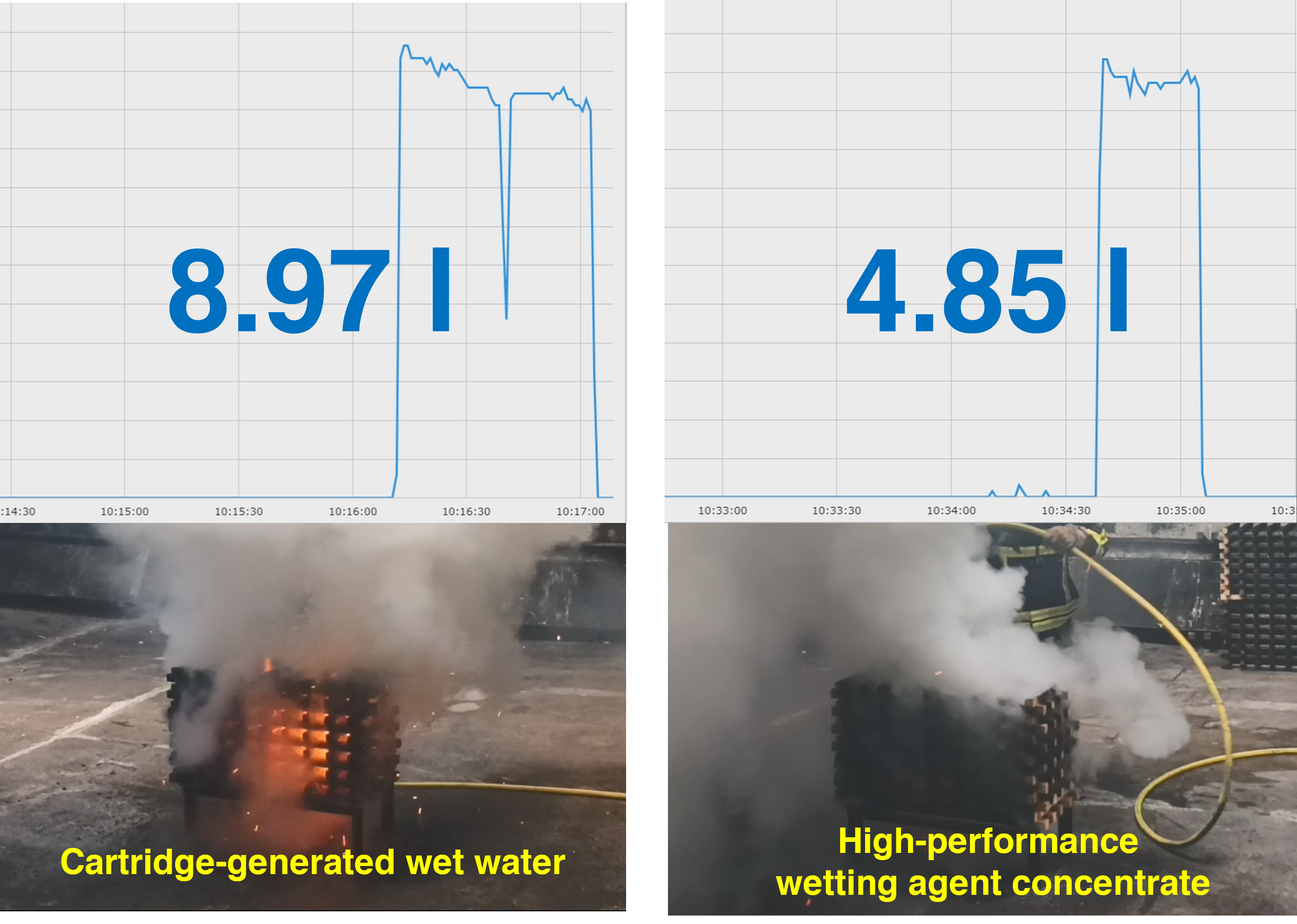
Standard wood crib, identical extinguishing technique: once with a conventional cartridge wetting agent, once with a liquid high-performance wetting agent such as STHAMER UltraWet 0.1 % F-25 liquid concentrate.
Result: 8.97 l of firefighting water needed versus 4.85 l. The effect tends to be even greater compared with plain water.
Video footage protected by copyright. Reproduction or distribution only with prior written permission.
Validation tests
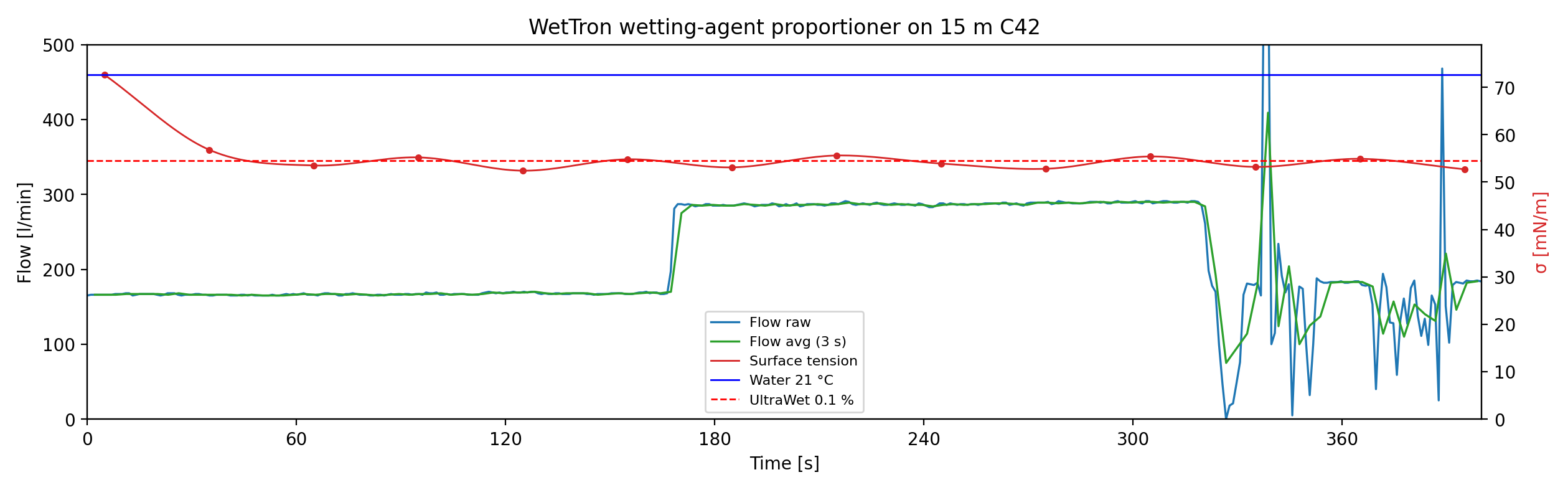
The measurement series shows realistic firefighting operation at the C nozzle in three phases: a steady discharge period at around 170 l/min, a higher constant discharge at around 290 l/min, and finally dynamic nozzle operation with deliberate start-stop changes, as occurs during pulse application or when working at a changing fire scene.
Despite these dynamic load changes, the surface tension of the samples remains largely constant and stays consistently close to the reference value for UltraWet 0.1 %. The downstream hose run acts as a mixing length and evens out short-term variations in proportioning.
Accurate proportioning within the target range also means that exactly the amount of wetting agent needed for the effect is used: no overdosing during peaks, no reserve. This noticeably lowers wetting-agent consumption and reduces both cost and environmental impact.
This confirms reliable wetting-agent performance even in real nozzle operation using pulse application technique.
Development basis
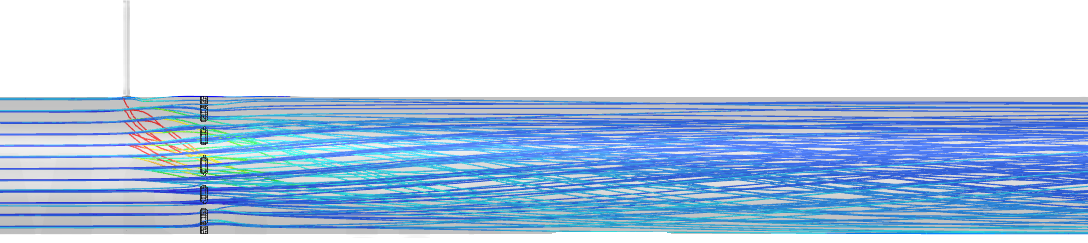 Flow simulation
Flow simulations and concentration measurements on the real firefighting setup confirm the even distribution of the wetting agent in the water flow. The downstream hose lines act as a mixing length: even a 15 m C hose is enough to fully even out short-term variations in proportioning.
The distribution remains reproducible across the entire flow range, a prerequisite for the reliable effectiveness of the wetting agent in the field.
Applications
WetTron is designed for use on the B hose line and is suitable for any situation in which wet water noticeably improves the extinguishing result.
Deeper penetration into wood, textiles and smouldering nests: less overhaul work, lower water demand.
Reduced water ingress limits secondary damage from firefighting water and shortens the drying phase.
Battery operation and a compact design enable use even far from a fixed supply, with any pump in the line.
Contact
If you are interested in the product or would like more information on applications, technology or demonstrations, we would be glad to hear from you by e-mail.
We advise you on configuration, integration into existing firefighting setups and trials in your brigade.